
How to keep your house cool in an Indian summer without relying on AC
By Red Brick Studio · · 3 min read

Stop the heat getting in before you try to remove it. Shade the walls and windows, keep west-facing openings small, let cool night air through the house, and use thick or well-insulated walls and roofs. Most of this costs little if decided at design stage and much more to add later.
Start with shade
The most effective step is keeping the sun off walls and windows in the first place. Roof overhangs, deep verandahs, pergolas, louvres and trees all do this. Large east and west windows are the hardest to shade, because the sun is low, so keep them small or protect them with screens.
In an existing house, outside shading such as bamboo screens, awnings or planting works better than curtains inside, because the heat has already entered the room by the time it reaches the curtain.
Orientation and plan
If the plot allows, a long axis running east to west leaves the large faces of the building to the north and south, which are much easier to shade.
The plan also decides how air moves. Openings on opposite or adjacent walls let air pass through a room. A single window in one wall does far less.
Ventilate at the right time
Moving air helps only when the air outside is cooler than the air inside. In a hot afternoon, opening every window can make a house hotter. A better pattern in many Indian cities is to close up and shade the house during the day, and open it at night and early morning to flush out the heat. Clerestory windows and high-level openings let hot air leave from the top of the room.
Walls, roofs and materials
The roof takes the most sun, so it is the first place to improve: reflective finishes, insulation, a shaded terrace, or a planted or double roof. Thick masonry or earth walls absorb heat slowly and give it back after the sun has gone, which evens out the temperature across the day. The trade-off is that thicker walls take up floor area, which matters on a small plot.
Courtyards, water and planting
Shaded courtyards, verandahs, water features and planting have cooled Indian buildings for centuries, because evaporation and shade lower the air temperature around the house. They also give the rooms around them a second source of light and air.
How some of our houses approach it
- Cove House at Panshet is sunk into the ground under a single curved roof, with a continuous clerestory window between the roof and the walls so air and light move through the house.
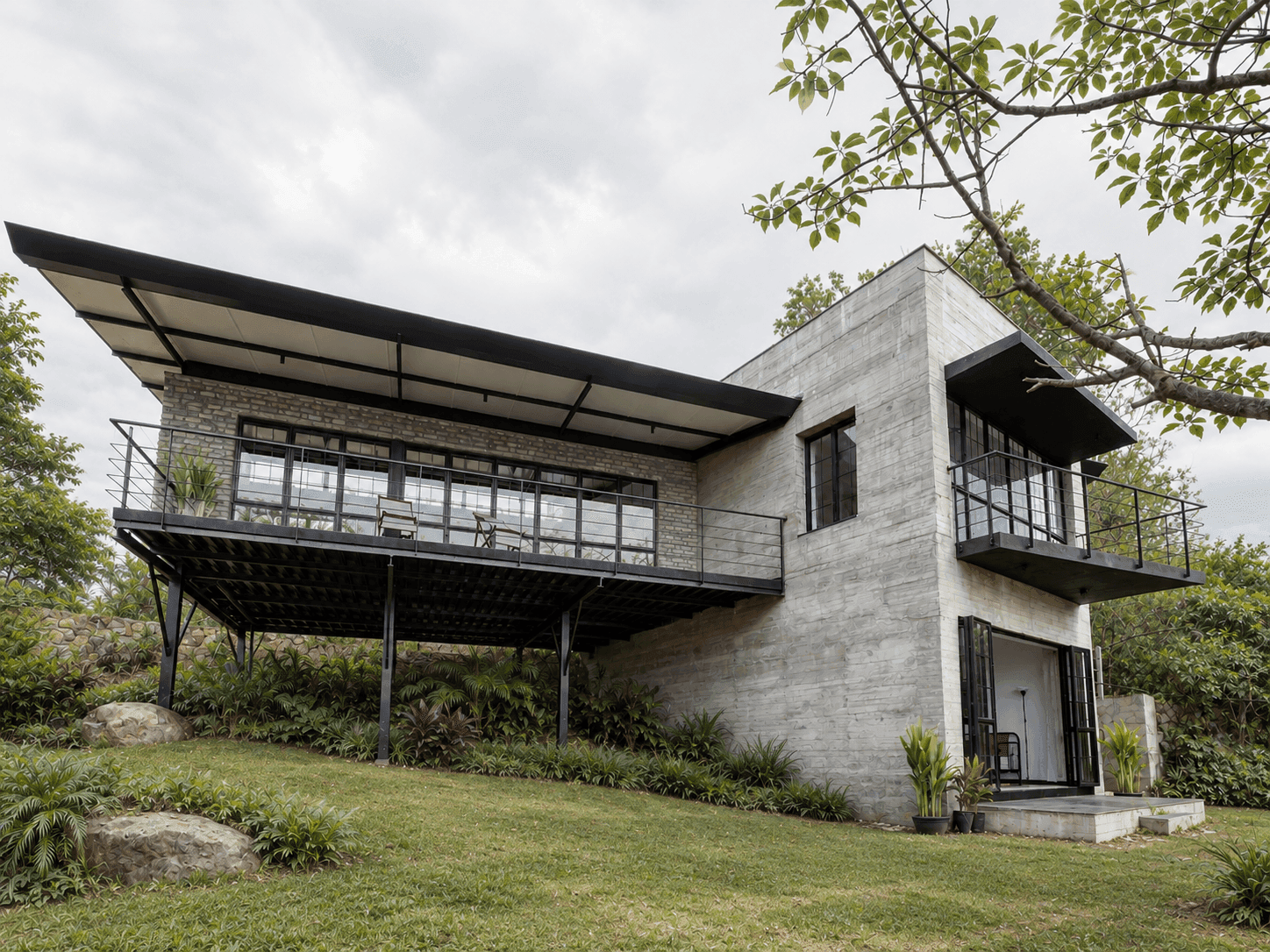
- Oblique House at Uksan Lake has one arm embedded in the slope and the other stilted over it, with minimal ground impact and a lower energy load as aims, using materials and technologies suited to the place.
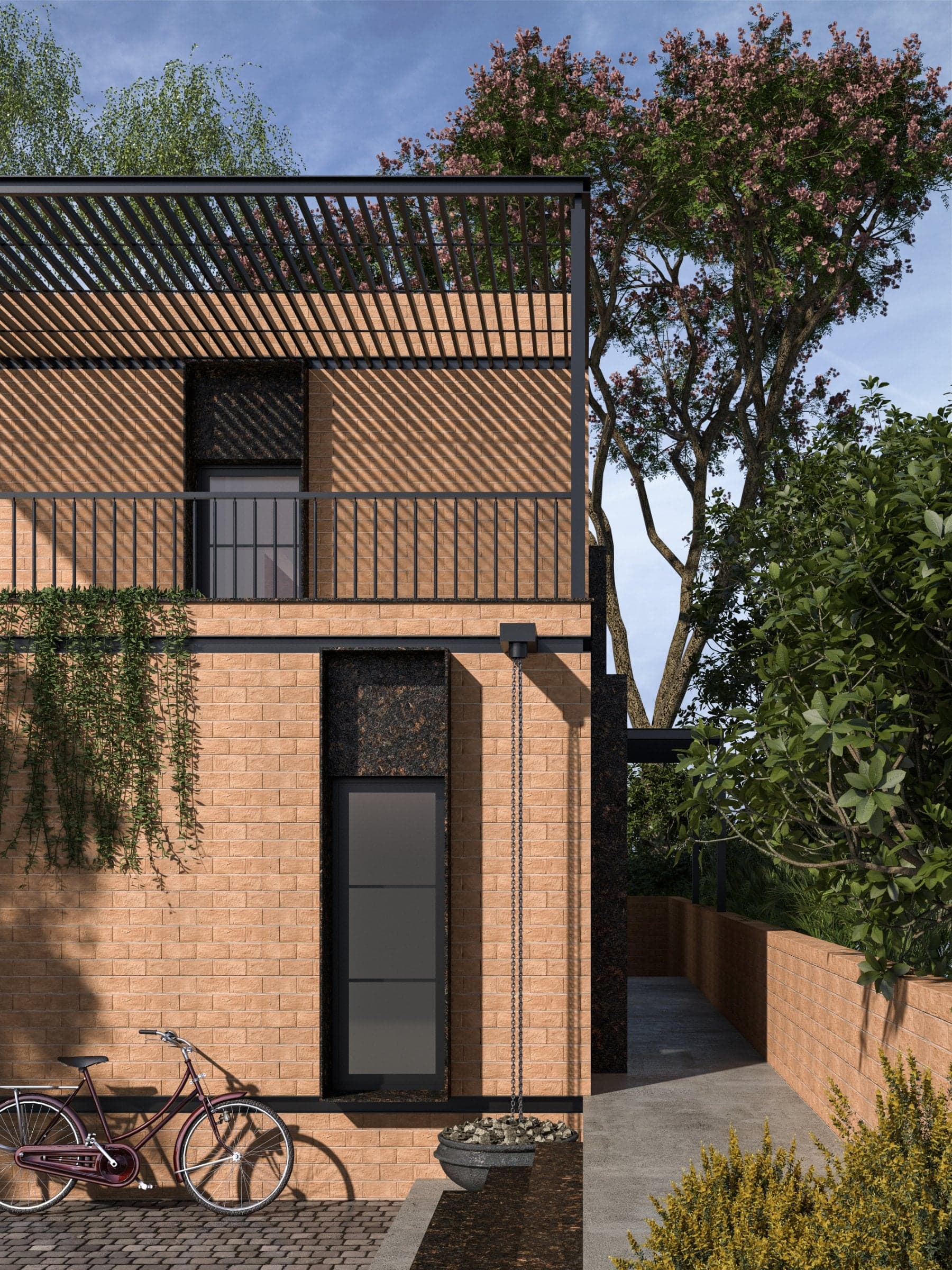
- Urban Mud House in Hyderabad uses earth and brick, materials known to moderate indoor temperature. See our guide on whether a mud house is practical in a city.
No single trick works everywhere. A strategy that suits dry Rajasthan can fail in humid Kerala, so the design should follow the local climate. If you are planning a house and want it to need less cooling, talk to us before the layout is fixed, because that is when it costs least.
Common questions
- Can a house stay comfortable in an Indian summer without AC?
- In many climates a well-designed house can stay much more comfortable with shade, ventilation and good materials. Whether you can do without AC entirely depends on the city, the season and how you use the house.
- Does passive design cost more?
- Several measures, such as orientation, window placement and shading, add little to construction cost when decided early. Some, such as thicker walls or roof insulation, cost more or take up space.
- What can I do in a flat I cannot rebuild?
- Shade the windows on the outside, reflect heat off the roof or balcony if you can, ventilate at night and early morning, and keep the sun off west-facing glass in the afternoon.
- Does the same approach work in Mumbai and Delhi?
- The principles of shade, ventilation and materials are shared, but the details differ. Humid coastal cities need more air movement, and dry inland cities benefit more from thermal mass and night cooling.
Projects mentioned
Sources for general guidance
Planning a project?
Red Brick Studio is an architecture, interior and landscape studio in Pune. Tell us about your site and what you have in mind.
Start a conversation